
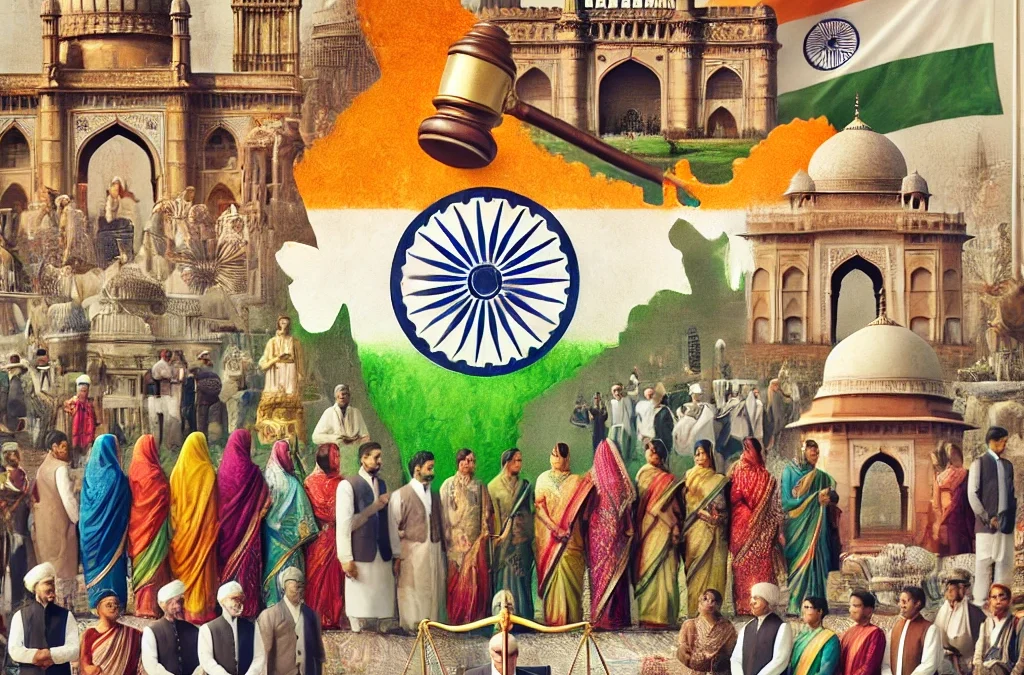
India is renowned for its rich tapestry of cultures, religions, and traditions. This diversity, while a source of strength and uniqueness, also poses significant challenges when it comes to legal uniformity. The idea of a Uniform Civil Code (UCC) — a single set of laws governing personal matters such as marriage, divorce, inheritance, and adoption for all citizens regardless of their religion — has been a subject of intense debate for decades. Although the Indian Constitution envisions a secular state and guarantees equal rights, the practical implementation of a UCC has remained elusive.
One of the primary obstacles to a UCC is India’s pluralistic society. In a country where personal laws are deeply intertwined with religious beliefs and cultural practices, any attempt to impose a common code is seen by many as an infringement on religious freedom and community autonomy. For instance, Hindu, Muslim, Christian, and Parsi communities each have their own personal laws that have evolved over centuries. These laws are not just legal guidelines but are also embedded in the social and cultural identities of these communities. As a result, any move toward a UCC is met with apprehension and resistance from groups that fear the dilution or loss of their traditional practices.
Constitutionally, Article 44 of the Directive Principles of State Policy encourages the state to secure a Uniform Civil Code for all citizens. However, Directive Principles are not enforceable by any court, which means that despite the noble ideal, the implementation of a UCC remains at the discretion of the government. This discretionary nature often leads to a cautious approach by policymakers, who are wary of the social and political fallout that might arise from altering deeply rooted personal laws.
Political considerations further complicate the issue. Lawmakers face a delicate balancing act between promoting national unity and respecting the regional and religious diversity that defines India. Proponents of a UCC argue that a common code would promote gender equality, eliminate discriminatory practices, and streamline legal procedures. Yet, opponents contend that enforcing a single law could marginalize minority voices and erode the cultural fabric that has long characterized India. Political parties and leaders are often hesitant to take a definitive stand on this issue for fear of alienating significant voter segments.
Moreover, judicial interpretations have added another layer of complexity. Courts have historically upheld the right of communities to maintain their personal laws, emphasizing the need to respect cultural diversity. Landmark cases have acknowledged the importance of personal law in preserving the identity of various communities. This judicial stance underscores the principle that legal reforms in personal law must be approached with sensitivity and an appreciation for the historical context of these laws.
Economic factors also play a role. Implementing a UCC would require a comprehensive review and overhaul of existing legal frameworks, which could be both time-consuming and expensive. The transition to a uniform system would necessitate widespread education, training, and infrastructural adjustments to ensure that the new code is effectively enforced. Given the scale of these changes, the economic cost is another deterrent for policymakers.
Despite these challenges, there is a growing discourse around reforming personal laws to enhance gender justice and promote equality. Incremental changes, such as amendments to existing laws, are being pursued in some communities. However, these piecemeal reforms often fall short of the sweeping changes envisioned by proponents of a UCC. The debate thus continues, with voices on both sides offering valid points: the need for a modern, egalitarian legal system versus the preservation of cultural and religious diversity.
In essence, the quest for a common uniform civil code in India is as much a social and political challenge as it is a legal one. The diversity that enriches the nation also demands a careful, nuanced approach to reform. While a fully uniform code may be a distant goal, the ongoing dialogue around this issue remains vital. It forces us to reconsider how best to balance individual rights with collective identity and how to ensure that legal reforms are inclusive without being homogenizing.
Ultimately, the difficulty in achieving a UCC reflects the broader challenge of governance in a diverse society. The debate is likely to continue for the foreseeable future, with incremental changes paving the way for gradual convergence rather than an immediate, sweeping reform. This complex interplay of law, culture, politics, and economics makes the prospect of a one-size-fits-all civil code not only challenging but also a subject that requires ongoing reflection and discussion.